Legislative Updates

OCTOBER 2026
Better Access to Care Remains the Goal for Ohio
OAAPN continues to support Better Access to Care, including the removal of Ohio’s Standard Care Arrangement requirement for APRNs. The SCA is more than an administrative requirement. It ties an APRN’s ability to practice to a state-mandated contract with a collaborating physician or podiatrist, even when the APRN is already educated, nationally certified, and licensed to provide that care.
That barrier is especially serious in rural and underserved communities. When an eligible collaborating physician is unavailable, unwilling to enter an arrangement, or leaves a community, an APRN may be unable to begin or continue practicing. Patients can lose a trusted provider, face longer travel and wait times, or go without timely care altogether.
JUNE 12, 2026
Message from OAAPN President, Eric Snyder, DNP, APRN-CNP: June 12, 2026
Use this time to stay engaged. Watch the testimony. Read the written statements. Talk to your colleagues, your organizations, and your legislators about what you’re seeing in your own communities. Because once you recognize it, you start to see it everywhere. Provider shortages. Health care deserts. Patients waiting weeks for care when qualified conditions stand ready to help.
That’s access suppression, not a slogan. A reality that happens when outdated systems and unnecessary barriers prevent patients from getting timely care. We’ll continue providing updates as these bills move forward this fall. Until then, stay engaged, stay informed, and keep telling the story of what access really looks like in Ohio. Together, we’ll move this state forward.”
JUNE 9, 2026
SB 258 UPDATE
MAY 19, 2026
HB 508 UPDATE
Now is the time to take action. Please contact your Ohio House representatives to ask for their support for HB 508.
Personal letters and emails from constituents can make a meaningful difference in helping legislators understand the importance of this bill and will encourage them to vote “Yes” tomorrow in committee.
Together, we can help advocate for policies that support individuals, families, and healthcare professionals across Ohio.
Thank you for lending your voice and staying engaged.
Read More
Ohio APRNs & Patients: Your Voice Is Needed NOW
The Ohio House Medicaid Committee could vote on HB 508 in the coming weeks, and legislators need to hear from you.
If you are an APRN, healthcare professional, or a patient who values access to APRN care, please take a moment to contact your Ohio legislators and ask them to vote YES on HB 508.
Find your legislator here: https://www.legislature.ohio.gov/
Let’s set the record straight about HB 508:
- HB 508 does NOT change APRN scope of practice.
- HB 508 does NOT eliminate collaboration. Collaboration remains a professional standard in healthcare.
- HB 508 does NOT claim APRNs and physicians are interchangeable.
What HB 508 does address is access to care.
Ohio—and the entire country—needs more healthcare providers to meet patient demand. APRNs are highly trained professionals who already provide safe, high-quality care across the state.
The bill also includes 5,000 clinical practice hours, completed under the current standard care arrangement, before practice authority changes.
- This requirement was added in response to stakeholder concerns.
- It is the highest hour requirement of any state.
- 27 states, 2 U.S. territories, and the VA have no hour requirement at all.
Patients deserve choice, access, and timely care.
Now is the time to speak up.
Contact your Ohio legislators and tell them why HB 508 matters to you and your patients.
House Bill 508 Opponent Testimony
“If you didn’t watch yesterday’s opponent testimony on HB 508… you need to. Not for my interpretation — but to hear, with your own ears, how a select group of organizations talked about APRNs in front of policymakers.
Watch the pivots. Watch what gets exaggerated… and what quietly gets avoided. Watch the “solutions” they offer that still keep APRNs behind a gate.
Then ask yourself one question: Is this about patients… or is this access suppression?
Leave your comments. Share your thoughts. Pass it on to your colleagues, your students, your preceptors.
This is our moment — let’s show Ohio what united APRNs can do.”
– Eric Snyder, DNP, APRN-CNP, OAAPN President
November 2025
Watch the full testimony stream.
House Bill 508 Proponent Testimony
House Bill 508 Introduced
Retirement of Standard Care Arrangement (SCA) for APRNs Gains Momentum with Senate and House Bills
On September 9, 2025, Ohio Senators George Lang and Mark Romanchuk introduced Senate Bill 258 — The Better Access to Healthcare Act, a historic step toward removing the outdated Standard Care Arrangement (SCA) for Advanced Practice Registered Nurses (APRNs).
And now, the momentum has doubled. On the heels of SB 258, Representatives McClain and Barhorst introduced House Bill 449, identical legislation in the Ohio House of Representatives. Yes — we now have strong sponsors in both chambers.
Why This Matters
The introduction of HB 449 alongside SB 258 signals broad, bipartisan commitment to finally modernize Ohio law and allow APRNs to practice to the full extent of their training. Eliminating the SCA will:
- Expand patient access to high-quality care, particularly in underserved areas.
- Reduce unnecessary administrative burdens that delay treatment.
- Strengthen Ohio’s healthcare system by empowering APRNs to meet community needs.
It is important to note, these bills are not a scope expansion bill, but rather a removal of a state-mandated, unfunded contract. Each piece of legislation enables APRNs to work to the top of their licensure, education, and training. Collaboration will still occur in healthcare; removal of the SCA does not eliminate that.
Telehealth
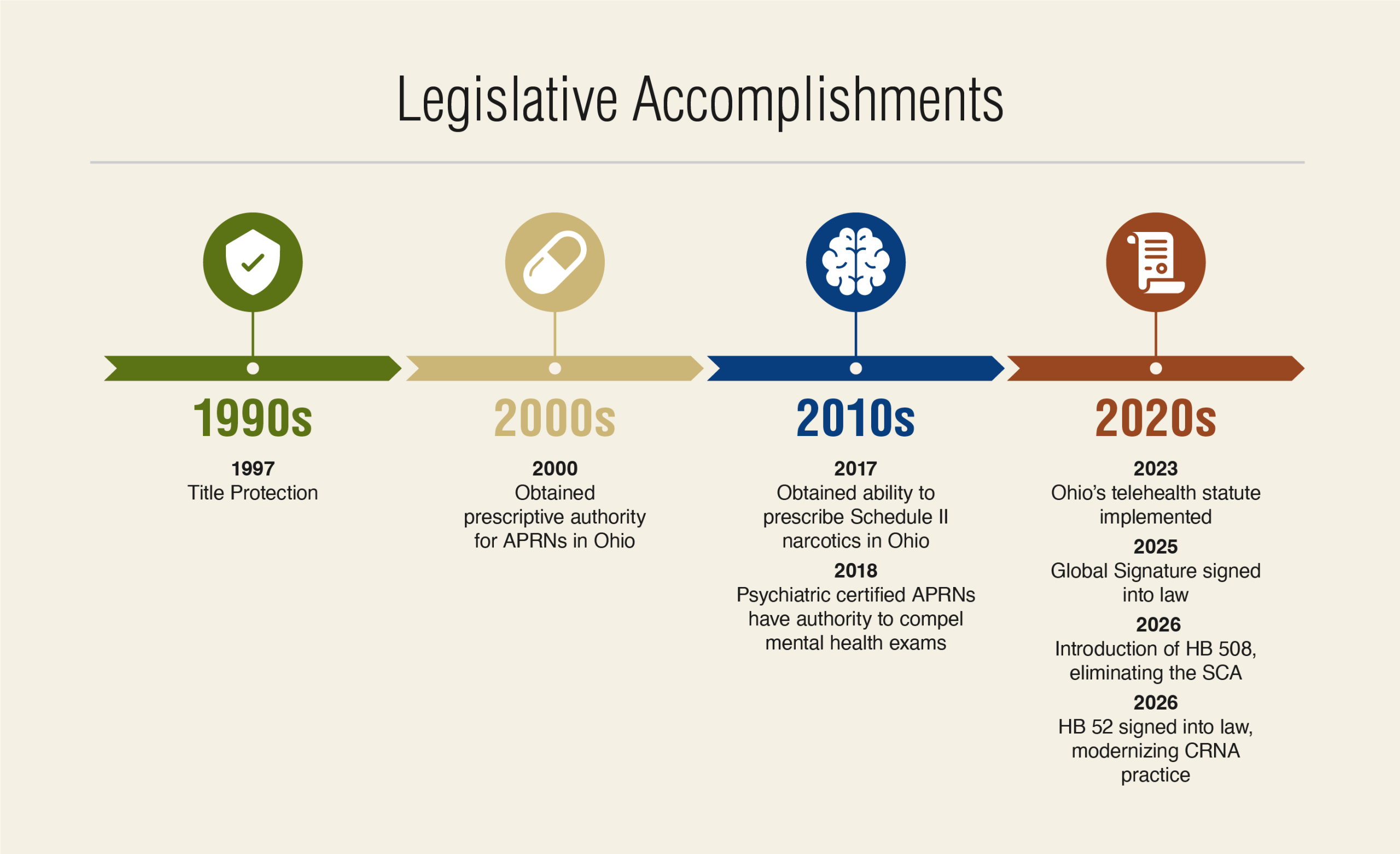
On February 21, 2023 the State Medical Board of Ohio released its final telehealth rules to implement Ohio’s telehealth statute (O.R.C. 4743.09) You can find a summary and more detailed information HERE.
Rule Comment Submissions
| Proposed Rule | Agency | Submission | Agency Response |
| OAC 4123-6-21.2 (Pharmacy and therapeutics committee) | Ohio BWC | Submitted 5.31.2024 | BWC refused to add NPs and CNSs to the Pharmacy & Therapeutics committee at this time. “While these individuals can prescribe medications, they may do so only in collaboration with one or more physicians. The P&T committee reviews issues specific to prescribing; therefore, the current committee requirement for physician is considered a “peer-to-peer” review.” |
| OAC 5160-27-01 (Community behavioral health services – request to add CNMs) | Ohio Department of Medicaid | Submitted 11.27.2023 | Medicaid requested a meeting to discuss. Such meeting occurred on 2.22.2024. Medicaid stated that they would be discussing internally and had no official timeline. We have followed up with the last follow-up being on 8.22.2024. |
| Medicaid Non-institutional Rate Increases (Request for 100% reimbursement) | Ohio Department of Medicaid | Submitted 10.9.2023 | Medicaid and OAAPN met on the topic 100% reimbursement. Medicaid responded on 11.14.2024 stating that APRNs are currently reimbursed at 100% in non-hospital settings. OAAPN also met with Medicaid on this topic in October 2023. The open question is whether OAAPN members are experiencing difficulty in receiving 100% reimbursement from Medicaid in non-hospital settings, as well as whether OAAPN wants to pursue 100% reimbursement rates in hospital settings. |
| OAC 5160-8-42 (Lactation consultant services) | Ohio Department of Medicaid | Submitted 9.19.2023 | OAAPN participated in a preliminary review of this rule and submitted a comment letter. Medicaid responded by pulling the original proposed rule and resubmitting a new version. OAAPN indicated on 8.6.2024 that the new version of the rule was acceptable and no further comments were submitted. |
| OAC 5122-40-05 | Ohio Department of Mental Health and Addiction Services | Submitted 4.14.2023 | The Department did not accept any of OAAPNs changes. No explanation offered. |
| OAC 5160-1-80 (pre-clearance review) | Ohio Department of Medicaid | Submitted 2.13.2023 | The Department adopted the proposed change to remove paragraph (B)(2) from the OAC 5160-1-80 rule. The Department did not adopt the second request for physician assistants to be added to the list of practitioners to perform the services of a locum tenens. ODM feels that this is not appropriate because services provided by a physician assistant require supervision by a physician. As stated in paragraph (B)(1) of OAC rule 5160-4-03, a physician assistant provides services under the supervision of a physician with whom the PA has entered into a supervision agreement. For this reason, ODM will not be adding PAs to the list of substitute practitioners at this time. |
| OAC 3301-69-02 | Ohio Department of Education | Submitted 2.13.2023 | Proposed changes were not adopted. |
| OAC 4729:1-3-02 | Ohio Board of Pharmacy | Submitted 1.31.2023 | Proposed changes were adopted, and new rule was finalized on 6.1.23. |
| OAC 5122-40-05 | Ohio Department of Mental Health and Addiction Services | Submitted 11.4.2022 | The Department has not finalized these rules as of 1.30.23. |
| OAC 5160-19-01 | Ohio Department of Medicaid | Submitted 10.3.2022 |
“Thank you for your comments on the draft amendment for OAC 5160-19-01 (C)(2), requesting the addition of “Advanced Practice Registered Nurses excluding Certified Registered Nurse Anesthetists” to the list of eligible providers and aligning the language in 5160-19-01 (C)(2) to reflect the existing language in 5160-19-01 (D)(2), citing section 4723.01 of the Revised Code. ODM recognizes and supports all providers practicing at the top of their licenses, including Certified Nurse Midwives (CNMs) providing primary care. However, ODM is currently working through major system updates bringing forth a new provider network module and a new fiscal intermediary. Adding new providers to these systems takes a great effort that cannot possibly be completed by the start of this 2023 program year. ODM will consider adding CNMs next year to further support the nursing workforce and allow CNMs to practice at the top of their licenses.” |
| OAC 4501:1-7-02 | Ohio Department of Public Safety | Submitted 5.20.2022 (via certified mail) | The Department made the requested changes. |
| OAC 5160-1-18 |
Ohio Department of Medicaid (telehealth) |
Submitted 5.13.2022 | At this time, ODM intends to keep the language as is in 5160-1-18 (D)(1) and 5160-1-168 (D)(2) regarding payment for evaluation and management services delivered through telehealth. Specific level of complexity terminology is included in the E&M code definitions we currently allow for codes 99202-99204 and 99211-99214 for new and established patients respectively. We will allow the more highly complex codes 99205 and 99215 to be provided by OhioMHAS certified behavioral health providers only. Ensuring the highest standards in quality of care is our greatest priority and the agency’s clinical team sustains support for required in-person physical exams for more complicated patients. |
| OAC 5160-2-17 | Ohio Department of Medicaid | Submitted 5.13.2022 | The Department is going to be making the suggested change. |
| OAC 5122-40-01, 5122-40-06 & 5122-40-08 | Ohio Department of Mental Health and Addiction Services | Submitted 4.22.2022 | The Department made no requested changes to OAC 5122-40-01 or 5122-40-06(E), (F)(3), (G), or (U)(7)(b). The Department did add language allowing a medical director or other “authorized prescriber” to prescribe per requested in OAC 5122-40-06(L) and (U)(6)(g). The Department did not add “advanced practice nurse practitioners” to OAC 5122-40-08(A)(1) and (A)(2) but did add “the physician, or their designees” instead. |
| OAC 4731-37-01 | Ohio Board of Medicine | Submitted 4.11.2022 | New rule has not been adopted yet as of 1.30.23. |
| OAC 5122-29-14 | Ohio Department of Mental Health and Addiction Services | Submitted 3.30.2022 | The Department is going to be making the suggested change. |
| OAC 5160-2-40 |
Ohio Department of Medicaid (Pre-certification review – Psych) |
Submitted 3.3.2022 (Comment period was cancelled, but we submitted comments as a preemptive measure.) | Rule was rescinded on 2.23.2022 and resubmitted. ODM incorporated all suggestions except allowing APRNs to make negative review decisions. |
| OAC 4121-3-09, 4121-3-15, and 4121-3-32 | Ohio Industrial Commission (Bureau of Worker’s Compensation) | Submitted 2.25.2022 | Rules are listed as under 5-year rule review. However, they are not currently scheduled for hearing. We submitted comments as a preemptive measure. |
| OAC 5160-2-13 | Ohio Department of Medicaid | Submitted 2.23.2022 | Rule package was withdrawn and resubmitted with some of OAAPN’s proposed changes. We have followed-up with Medicaid regarding incorporation of our comments in a future revision. |
| OAC 5123-2-06 | Ohio Department of Developmental Disabilities | Submitted 2.7.2022 | Section (C)(14)(h) was revised to allow APRNs to administer ECT but not prescribe. Addition of “Ohio Board of Nursing” to (D)(4)(a) was denied. |
| OAC 5160-5-01 |
Ohio Department of Medicaid (Dental Services) |
Submitted 2.2.2022 | Changes approved by Medicaid on 2.4.2022. |
| OAC 5122-2-13 | Ohio Department of Mental Health and Addiction Services | Submitted 12.20.2021 | Changes made by ODMHAS on 1.3.2021 |
| OAC 5160-8-42 | Ohio Department of Medicaid | Submitted 11.10.2021. | Medicaid provided clarifying comments on 11.22.2021 and explained why the requested changes were not necessary. |
|
OAC 5160-10-25 OAC 5160-21-05 OAC 5160-8-42 OAC 5160-21-04 |
Ohio Department of Medicaid (Maternal and Infant Support Program) |
Submitted 9.3.2021 | On 9.16.2021, Medicaid responded with clarifying comments, but no changes were made. Changes regarding services after 40 weeks of pregnancy, 2nd provider reimbursement during delivery, and STI/drug use/abuse counseling were “logged and will be considered in ODM’s next review of this rule.” |
| OAC 5123-7-08 | Ohio Department of Developmental Disabilities | Submitted 8.31.2021 | Change was approved to add APRNs as approved providers. |
| OAC 5160-19-01 | Ohio Department of Medicaid | Submitted 8.3.2021 | Changes denied. Medicaid has asked for examples of APRN practices who have enough covered lives to be PCMH practices. OAAPN was unable to locate such examples. |
|
OAC 5160-10-06 OAC 5160-10-07 |
Ohio Department of Medicaid | Submitted 7.27.2021 |
On 7.29.2021, Medicaid acknowledged that the requested changes were appropriate, but they decided they were not important enough to grant at this time. Medicaid indicated that these small changes would require them to re-start the rulemaking process.
OAAPN resubmitted the comments to JCARR on 8.3.2021. However, JCARR denied the changes. |
| OAC 1301-11-7-04 | Ohio Real Estate Board | Submitted 7.7.2021 | On 7.15.2021, a Real Estate Board represented indicated they would recommend making the changes. |
| OAC 5160-31-03 (Eligibility for enrollment in the PASSPORT HCBS waiver program) | Ohio Department of Medicaid | (Nothing submitted.) | |
| OAC 4123-6-21 (Payment for outpatient medication) | Ohio Bureau of Worker’s Compensation | Submitted 5.24.2021 | On 6.9.2021, BWC responded that it reimburses APRNs and will examine “physician” references to update to provider neutral language at the next rule review. BWC denied the request to include APRNs as a “physician of record.” Paragraph (J) was updated to be “provider” instead of “physician.” |
| OAC 4729-1-6-02 (Pharmacy consult agreements) | Ohio Department of Pharmacy | Correction submitted to Cameron McNamee on 5.18.2021. | Correction made by Ohio Department of Pharmacy on 5.18.2021. |
| OAC 5160-21-04 (Reproductive health services; pregnancy-related services) | Ohio Department of Medicaid | Submitted 5.7.2021. | Most changes were granted on 5.21.2021. |
| OAC 5160-18-01 (Freestanding Birth Center Services) | Ohio Department of Medicaid | Submitted 5.6.2021. | Medicaid is still developing rule to propose for 5-year rule review in 2022. |
|
OAC 5122-40-05 (Personnel) OAC 5122-40-06 (Medication Assisted Treatment administration) OAC 5122-40-07 (Program policies and patient records) OAC 5122-40-08 (Monitoring program) |
Ohio Department of Mental Health and Addiction | Sent to OAAPN on 4.15.2021. Nothing submitted. |
2026 YEAR IN REVIEW
If you have any questions about how these change impact your practice, please contact OAAPN General Counsel, Jeana Singleton at jmsingleton@bmdllc.com.
Psychiatric Inpatient Documents
Effective September 20, 2024, Senate Bill 81 gave APRNs the ability to sign documents related to the admission, discharge, and treatment of psychiatric inpatients.[1] To be eligible to sign these documents, the following must be met:
1) The APRN must be employed by or have credentials at the facility;
2) The APRN’s collaborating physician is employed by or is a medical staff member at the facility;
3) The APRN’s collaborating physician has authorized the APRN to sign these documents for the physician’s patients; and
4) This authority is set forth in the APRN’s standard care arrangement.[2]
[1] See ORC 4723.436.
[2] See ORC 4723.436(B).
Signature Authority
We kicked off 2025 celebrating the passage of Senate Bill 196, also known as Global Signature. As a result of Global Signature, APRNs may now sign and complete certain paperwork associated with patient care within their scope of practice. APRN signature recognition extends to several different patient care forms including certification of disability for patients to receive disabled parking placards and patient orders for life-sustaining treatment (POLST) and other end-of-life care documents. Although APRNs are still not permitted to sign death certificates, Global Signature expanded a CNS’s, CNP’s, and CNM’s authority to determine and pronounce an individual’s death.[1] APRNs may also now develop protocols and authorize pharmacists to use such protocols for dispensing nicotine replacement therapy and epinephrine.[2] While we continue to advocate for greater APRN signature authority, Global Signature was a positive step for both APRNs and patients across the state.
[1] See ORC 4723.431(B)(5); see also ORC 4723.36.
[2] See ORC 4723.4812.
Read More
Duties Related to Fetal Death
Senate Bill 196 also established a new provision in the Ohio Nurse Practice Act related to fetal death.[1] If a woman presents herself to a CNM, CNS, or CNP as a result of experiencing a fetal death, and the woman is not referred to a hospital, the APRN must provide the woman with the following:
- A written statement, not longer than one page in length, that confirms that the woman was pregnant and that she subsequently suffered a miscarriage that resulted in fetal death;
- Notice of the right of the woman to apply for a fetal death certificate;
- A short, general description of the nurse’s procedures for disposing of the product of a fetal death.[2]
A copy of the written statement and documentation that the requirements listed above were provided must be documented in the woman’s medical record.[3]
[1] See ORC 4723.437.
[2] See ORC 4723.437(B).
[3] See ORC 4723.437(C).
Retail IV Therapy Clinics
The Ohio Board of Nursing (the “Board”), along with the State Medical Board of Ohio and the Ohio Board of Pharmacy, issued a joint regulatory statement this past May in response to the increase of retail IV therapy clinics across the state.[1] This guidance document confirms that the preparation of IV cocktails, such as Myers’ Cocktail (magnesium, calcium, vitamin B complex, and vitamin C), is considered compounding under Ohio law.[2] The boards clarify that compounding may only be performed by a licensed pharmacist or licensed health professional authorized to prescribe drugs.[3] Further, clinics engaged in compounding are required to be licensed as a terminal distributor of dangerous drugs (TDDD) by the Ohio Board of Pharmacy.[4] The boards also make clear that the use of protocols for the administration of IV therapy is prohibited.[5] We recommend that our members who offer IV therapy as part of their practice review this guidance carefully.
[1] See Joint Regulatory Statement of the State Med. Bd. of Ohio, Ohio Bd. of Pharmacy, and Ohio Bd. of Nursing Regarding Retail IV Therapy Clinics (attached).
[2] Id at 3.
[3] Id.
[4] Id.
[5] Id. at 4.
Release from Permanent Restrictions
The Board created a protocol establishing a process for a licensee, such as an APRN, to petition the Board for a release from, or an amendment to, permanent restrictions placed upon their license by a Board Order or Consent Agreement.[1] While this will not remove discipline from an APRN’s record, the protocol provides a pathway to request permanent restrictions be lifted. To be eligible to apply for a release from permanent restrictions, an APRN must meet the following:
- Be released from all terms in the Board Order or Consent Agreement before petitioning for release from, or an amendment to, permanent restrictions;
- An APRN must have not have discipline pending or have been issued discipline by the Board or any other nursing board since their release from the Board Order or Consent Agreement that contains the permanent restrictions;
- In the event the Board action was based upon a criminal conviction, including intervention in lieu of a conviction, the APRN must have complied with and completed all terms imposed by the criminal court; and
- If the permanent restrictions are based upon the APRN’s substance use disorder, the APRN has maintained their abstinence since their release from the Board Order or Consent Agreement.
[1] See Release from Permanent Restrictions, Ohio Bd. of Nursing (attached).
Disciplinary Action
Ohio House Bill 96 passed at the end of June 2025, adding to the list of acts that would invoke Board disciplinary action. Now, the Board make take action against an APRN for his or her failure to cooperate with a Board investigation. This includes the failure to comply with a subpoena or order issued by the Board and the failure to answer truthfully to a question presented by the Board in an investigative interview, in an investigative office conference, at a deposition, or in written interrogatories.[1]
[1] See ORC 4723.28(B)(39).
Course on Drugs and Prescriptive Authority
The Board recently relaxed documentation requirements for applicants for APRN licensure with respect to a course of instruction in Ohio law governing drugs and prescriptive authority. Now, applicants must simply attest to the completion of this course in place of submitting an original certificate demonstrating competition.[1] However, the Board may require this documentation upon request.[2] As such, APRNs are still encouraged to maintain original certificates for completed continuing education coursework.
[1] See OAC 4723-9-11(B).
[2] See OAC 4723-9-11(C).
Overdose Reversal Drugs
The Board recently revised its rules related to overdose reversal drugs.[1] Previously, an APRN could personally furnish a supply of naloxone. The Board has since replaced all references to “naloxone” with “overdose reversal drug”, broadening this authority.[2]
[1] See OAC 4723-9-08; see also OAC 4723-9-10; see also OAC 4723-9-14.
[2] Id.
Office Based Opiod Treatment
The Board updated the terminology and authority of APRNs with respect to office based opioid treatment.[1] The new rule provides APRNs with greater autonomy to determine psychosocial interventions and to make referrals when appropriate, removing the requirement that the APRN work together with a qualified behavioral health provider, community addiction services provider or community mental health services provider to create a psychosocial treatment plan.[2] However, an APRN is now required to have a discussion of all medications for opioid use disorder (MOUD) and non-medication options with a patient before selecting a specific drug to be used in treatment.[3]
[1] See OAC 4723-9-13. Previously, the rule referred to this treatment as “medication assisted treatment.”
Withdrawal Management for Substance Use Disorder
The Board updated its terminology with respect to the treatment of substance use disorders and imposed a requirement that a patient be referred to a higher level of care if withdrawal management is unsafe or inappropriate for the patient.[1] Additionally, APRNs may not prescribe or dispense more than one week of unsupervised or take-home medications to a patient in a withdrawal management program lasting thirty days or less.[2] In terms of overdose reversal drugs, an APRN is now required to either offer patients in a withdrawal management program a prescription for an overdose reversal drug, directly provide them with this drug, or direct the patient to an easily accessible source to obtain the drug.[3] If possible, the APRN must ensure those residing with the patient receive instruction on the overdose reversal drug’s use in addition to the patient themselves.[4] An APRN is required to instruct patients on the withdrawal management process and the importance of subsequent treatment for substance use disorder, the risk of relapse and lethal overdose following completion of withdrawal without entry into continuation of treatment for substance use disorder, and the safe storage and disposal of prescribed medications.[5]
[1] See OAC 4723-9-14.
[2] See OAC 4723-9-14(F)(9)(c)(iii).
[3] See OAC 4723-9-14(F)(10).
[4] Id.
[5] See OAC 4723-9-14(G)(9).
Safe Haven Program
As required by the Ohio Nurse Practice Act, the Board established a safe haven program to monitor applicants and practitioners who are or may be impaired, but whom the Board has refrained from taking disciplinary action.[1] Modeled after the State Medical Board of Ohio’s Confidential Monitoring program, the safe haven program is a confidential, non-disciplinary program for the treatment of impaired licensees, certificate holders and nursing board applicants.[2] To be eligible for the safe have program, the applicant or practitioner must (1) need assistance with an impairment or potential impairment and (2) have an unencumbered license and not be currently under the terms of a consent agreement with the Board for impairment or an order issued by the Board for impairment.[3]
[1] See ORC 4723.35(B); see also OAC 4723-19.
[2] See OAC 4723-19-01(A); see also Ohio Bd. of Nursing, OhioPHP, https://www.ohiophp.org/obn (last visited Nov. 4, 2025)
[3] See ORC 4723.35(G).
Laser Hair Removal – House Bill 377
House Bill 377, concerning laser hair removal, was recently passed in the Ohio House of Representatives and referred to the Senate Health Committee. If the bill ultimately passes, APRNs will be subject to this new law with specific provisions regarding an APRN’s authority to delegate and supervise a nurse or laser hair professional in the application of a light-based medical devices for the purposes of hair removal.[1]
[1] See House Bill 377.
[1] See ORC 4723.35(B); see also OAC 4723-19.
[2] See OAC 4723-19-01(A); see also Ohio Bd. of Nursing, OhioPHP, https://www.ohiophp.org/obn (last visited Nov. 4, 2025)
[3] See ORC 4723.35(G).
If you have any questions about how these change impact your practice, please contact OAAPN General Counsel, Jeana Singleton at jmsingleton@bmdllc.com.
OUR PARTNERS
We Stand for Better Healthcare Access for All Ohioans