Advanced Practice Registered Nurses (APRNs) care for Ohioans in communities and healthcare settings across the state. But APRN does not describe just one type of provider.
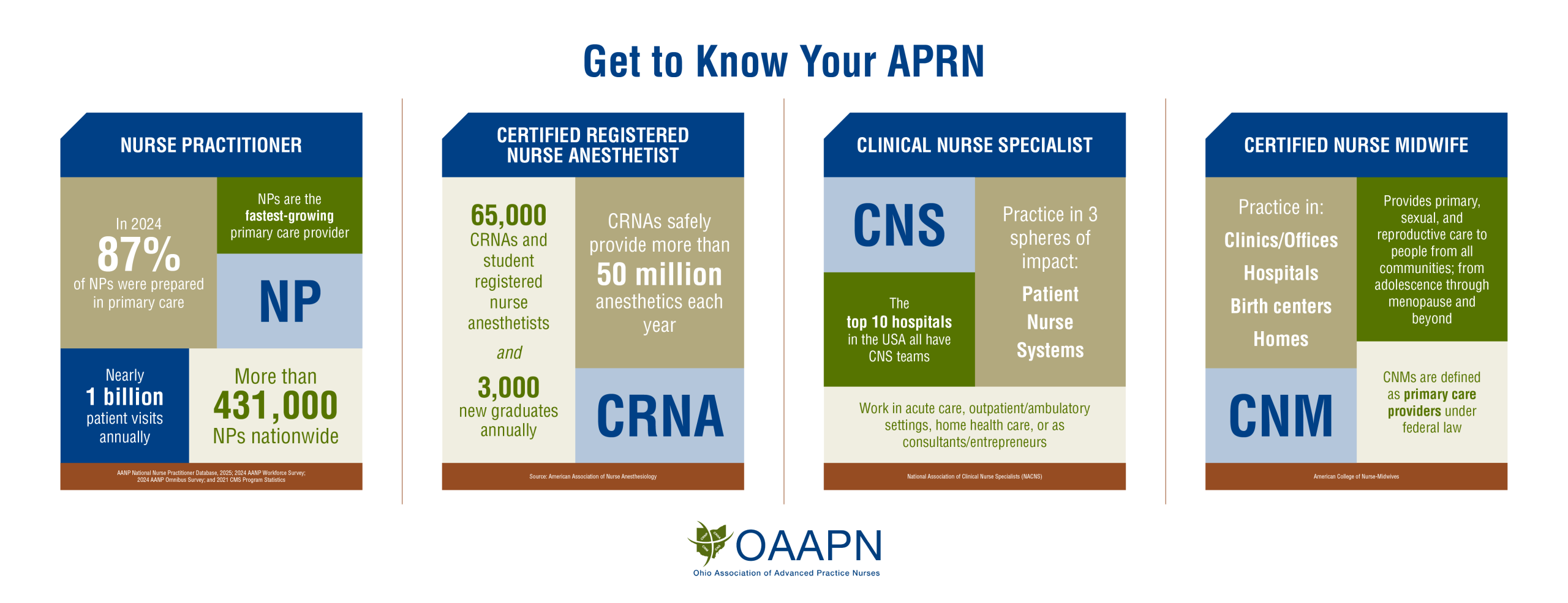
Ohio recognizes four APRN roles: Certified Nurse Practitioners (CNPs), Certified Registered Nurse Anesthetists (CRNAs), Clinical Nurse Specialists (CNSs), and Certified Nurse-Midwives (CNMs). Each has distinct training and areas of practice, but all are part of Ohio’s advanced practice nursing community.
Certified Nurse Practitioners (CNPs)
Certified Nurse Practitioners care for patients across a range of populations, specialties, and settings. In Ohio, CNPs are one of four recognized APRN roles, providing care that requires advanced formal education and clinical experience.
CNPs are also part of the larger conversation around access to care in Ohio. OAAPN continues to advocate for removing unnecessary practice barriers that can make it harder for qualified APRNs to care for patients, particularly in rural and underserved communities.
Certified Registered Nurse Anesthetists (CRNAs)
Certified Registered Nurse Anesthetists specialize in anesthesia care and are one of Ohio’s four recognized APRN roles.
The CRNA role looks very different from the other APRN roles, but CRNAs face many of the same broader issues affecting advanced practice nursing in Ohio. Their perspective is an important part of OAAPN’s work and Ohio’s APRN community.
Clinical Nurse Specialists (CNSs)
Clinical Nurse Specialists work across patient care, education, quality, informatics, and other areas of healthcare. OAAPN recently highlighted that range in its CNS career spotlight, showing how the role can evolve alongside changing patient and healthcare system needs.
CNSs are recognized as APRNs in Ohio and provide nursing care based on advanced formal education and clinical experience.
Certified Nurse-Midwives (CNMs)
Certified Nurse-Midwives are another of Ohio’s four recognized APRN roles. CNMs provide advanced nursing care to patients and families and are part of the broader APRN community represented by OAAPN.
Like CNPs and CNSs, CNMs can also be directly affected by Ohio laws governing APRN practice, including the state’s Standard Care Arrangement requirements.
Different Roles. One Voice.
CNPs, CRNAs, CNSs, and CNMs do different work. Their specialties, practice settings, and day-to-day responsibilities vary. But decisions affecting APRN practice can have consequences for both the profession and the Ohioans APRNs care for.
OAAPN continues to advocate for better access to care and the removal of unnecessary practice barriers in Ohio. Recent efforts have included work surrounding the standard care arrangement (SCA) requirement, which OAAPN has identified as a particular concern in rural and underserved communities.
Senate Bill 196, commonly known as the Global Signature legislation, took effect on March 20, 2025, and expanded APRNs’ authority to sign certain patient care documents within their scope of practice. OAAPN described the change as a positive step for APRNs and patients across the state.
With more than 25,000 APRNs in Ohio, there are thousands of different experiences, specialties and perspectives represented within the profession.
Frequently Asked Questions About APRNs in Ohio
What are the four APRN roles in Ohio?
Ohio recognizes four APRN roles: Certified Nurse Practitioner (CNP), Certified Registered Nurse Anesthetist (CRNA), Clinical Nurse Specialist (CNS) and Certified Nurse-Midwife (CNM).
How many APRNs are there in Ohio?
OAAPN represents the voice of more than 25,000 APRNs across Ohio.
What does OAAPN advocate for?
OAAPN advocates for Ohio’s APRNs and policies that improve access to care. Current priorities include removing unnecessary practice barriers, including Ohio’s standard care arrangement requirement.